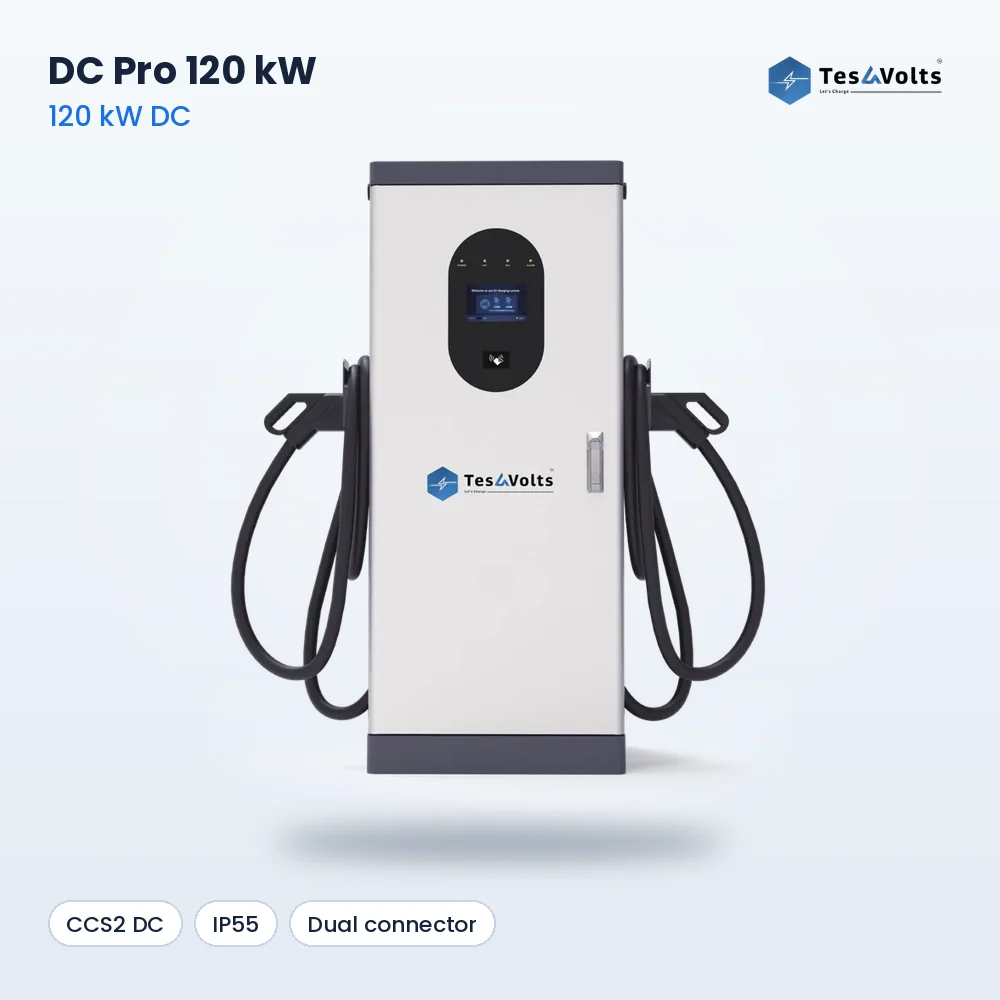

High-power DC charger
DC Pro 120 kW
The highway and fuel-station workhorse, two cars at once.
- Power
- 120 kW DC
- Connector
- CCS2
- Enclosure
- IP55
- Supply
- 127 kVA
Quoted per site incl. installation scope



Ai DC HyperChargers · DC Fast Chargers
Ai DC HyperChargers from 120 to 400 kW and compact 30 and 60 kW DC chargers, with CCS2 for every electric car sold in India and 150–1000 V output for buses and trucks. Open OCPP software, site survey, installation and operation from one team.

Electric cars sold in India use CCS2 for DC fast charging. Every Teslavolts DC charger has CCS2 connectors, and 150–1000 V output covers cars, buses and trucks.
Teslavolts chargers work with any electric car that has a CCS2 (DC) or Type 2 (AC) inlet; check your car's maximum AC and DC charging power.
CCS2 is the DC fast-charging inlet on electric cars sold in India, from hatchbacks to luxury SUVs.
150–1000 V output covers 400 V and 800 V vehicles, including e-buses and e-trucks with CCS2.
OCPP connects every charger to the charging software you choose. Drivers start with RFID, QR code, app or password.
IP55 cabinets, −30 to +50 °C operation, surge, earth-fault and over-temperature protection.
96%+ conversion efficiency and power factor of 0.99 or better, so more of your grid connection reaches the car.
Hundreds of DC chargers running on our own network, monitored around the clock.
Every DC charger is quoted for your site, with installation and grid connection. Tap Get a quote on any model.
DC fast charging from 120 to 400 kW for highways, fuel stations, bus and truck depots.
High-power DC charger
The highway and fuel-station workhorse, two cars at once.


Quoted per site incl. installation scope
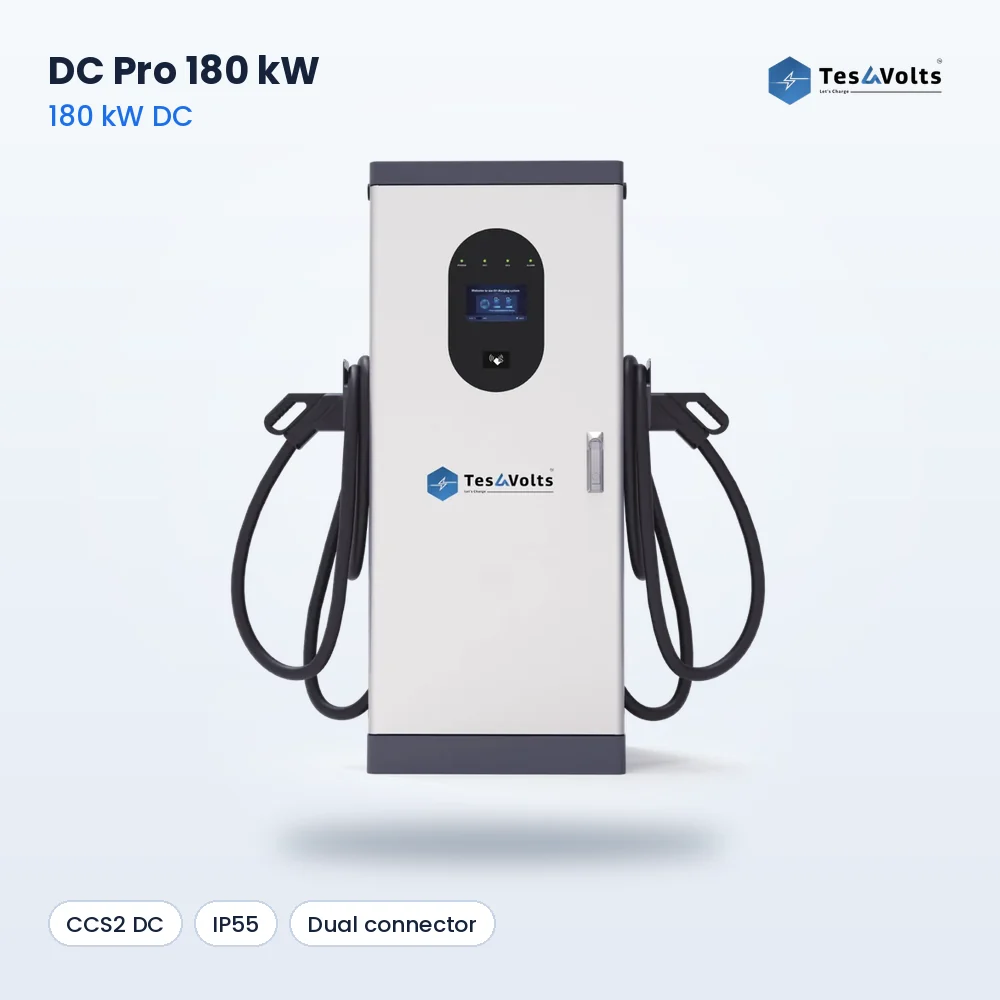

High-power DC charger
High-traffic highway hubs and mixed car and commercial fleets.
Quoted per site incl. installation scope
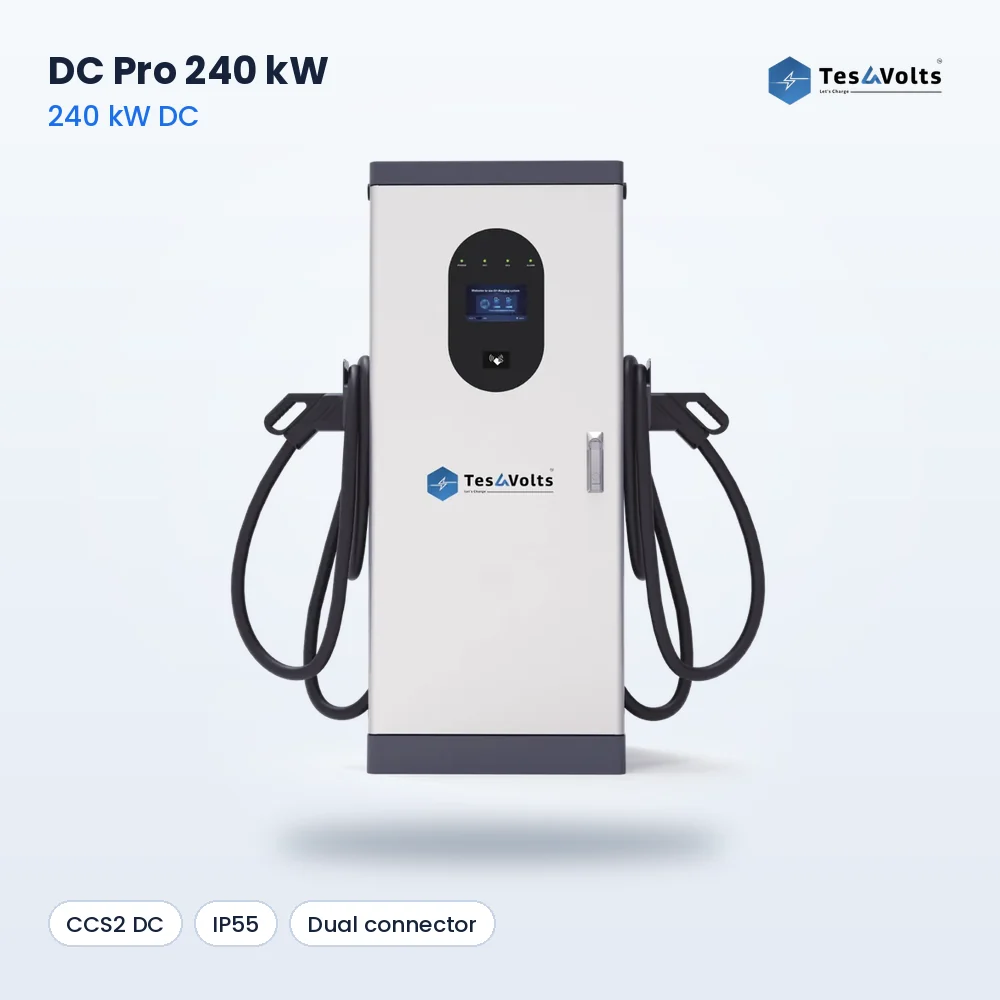

High-power DC charger
For e-buses, e-trucks and 800 V vehicles at depots and logistics hubs.
Quoted per site incl. installation scope
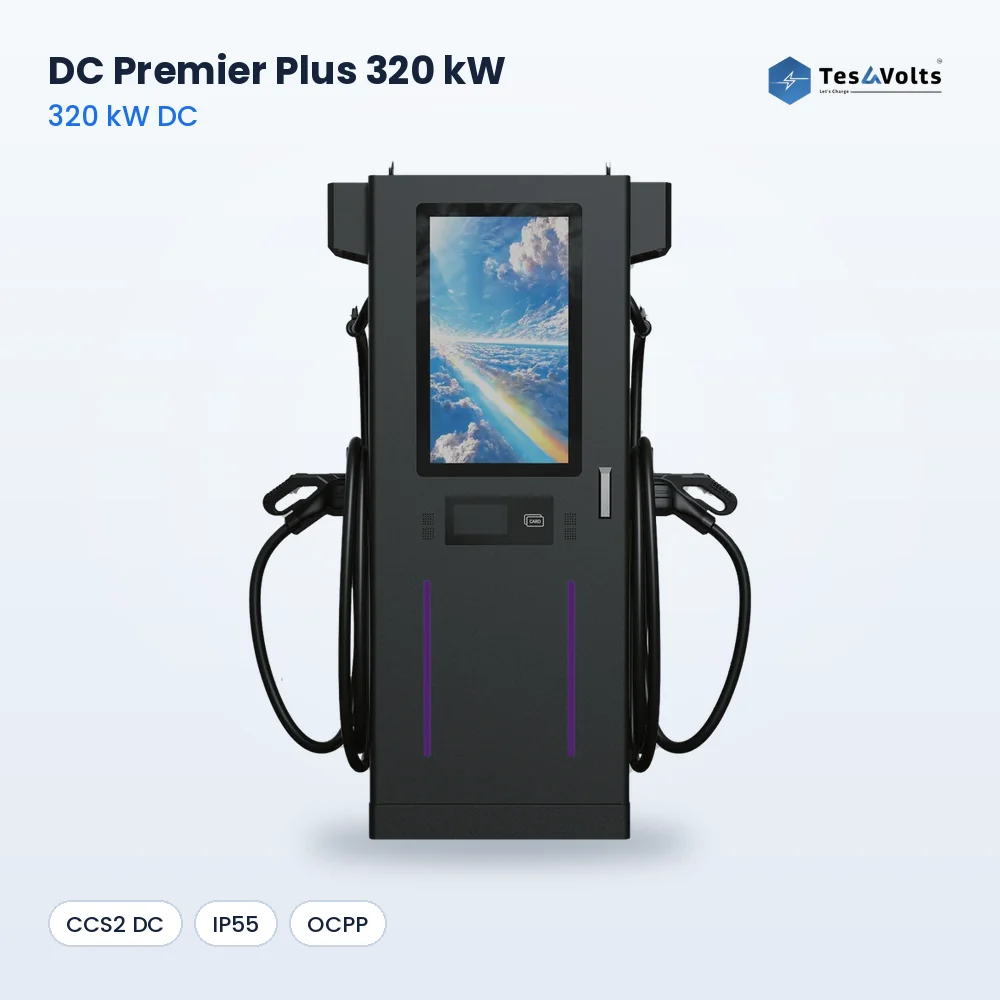

High-power DC charger
Flagship dual-gun DC station for highway hubs, e-bus and e-truck depots.
Quoted per site incl. installation scope


High-power DC charger
More power per bay for busy corridors and heavy commercial fleets.
Quoted per site incl. installation scope

High-power DC charger
The most powerful Teslavolts charger, for megawatt-scale depots and 800 V vehicles.
Quoted per site incl. installation scope
Compact 30 and 60 kW DC for workplaces, dealerships, retail and city sites.
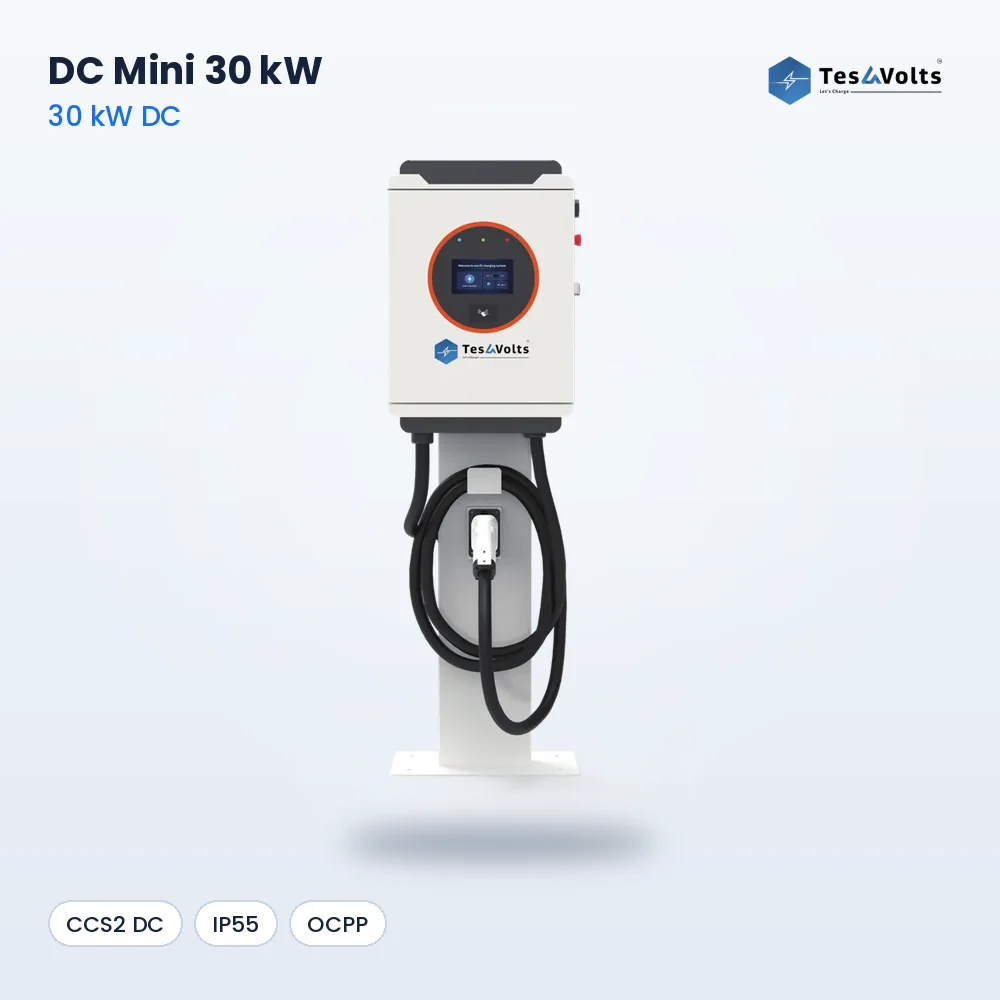

DC fast charger
Compact wall- or column-mount DC for workplaces, dealerships and city sites.
Quoted per site incl. installation scope
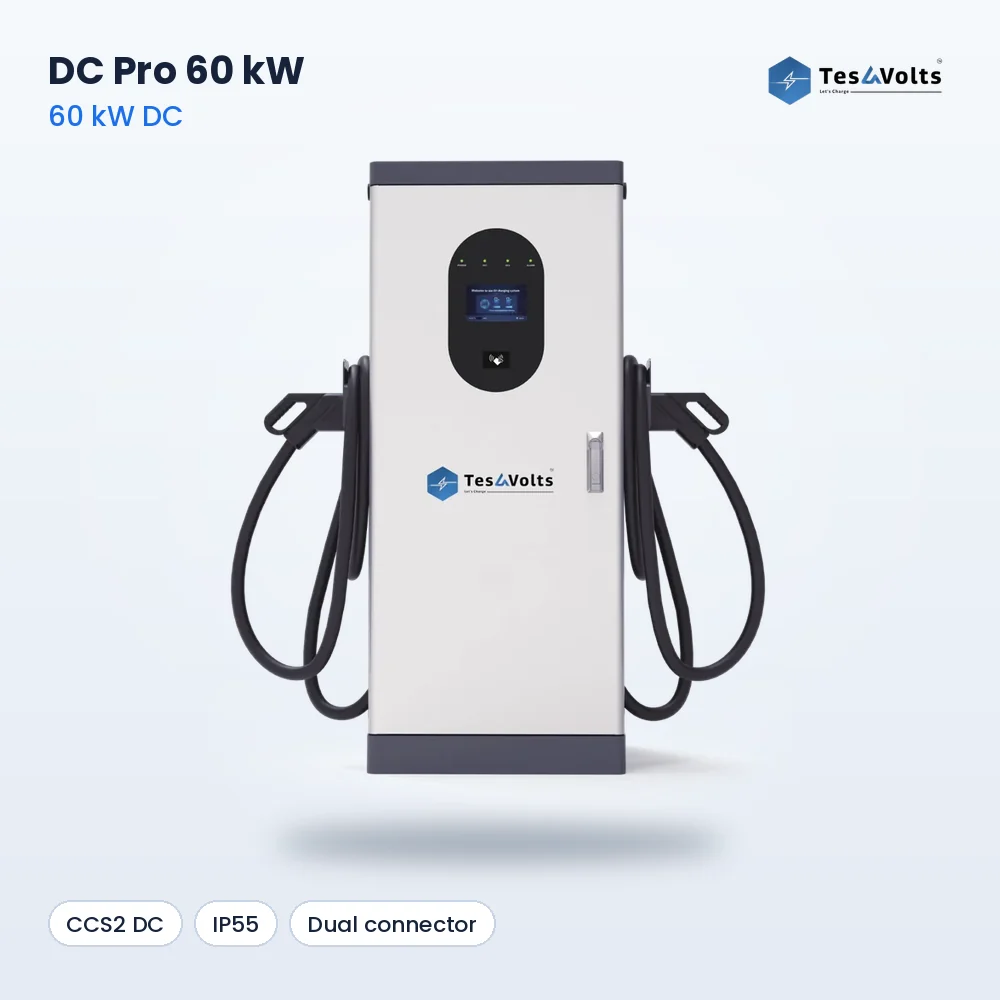

DC fast charger
Floor-standing DC fast charger for retail, hotels and fleet top-ups.
Quoted per site incl. installation scope
Our recommendation
120 kW DC
A starting point for your quote. Final sizing follows a site survey and load study.
| Model | Power | Type | Supply at full power | Enclosure | Key features | Price |
|---|---|---|---|---|---|---|
| DC Pro 120 kW | 120 kW DC | High-power DC charger | 127 kVA | IP55 | 150–1000 V output, 250 A per connector; Dual connector with power sharing | Get a quote |
| DC Pro 180 kW | 180 kW DC | High-power DC charger | 190 kVA | IP55 | 150–1000 V output, 250 A per connector; Dual connector with power sharing | Get a quote |
| DC Pro 240 kW | 240 kW DC | High-power DC charger | 253 kVA | IP55 | 150–1000 V output, 250 A per connector; Dual connector with power sharing | Get a quote |
| DC Premier Plus 320 kW | 320 kW DC | High-power DC charger | 337 kVA | IP55 | 150–1000 V output, 250 A per connector; 32″ LCD touchscreen; RFID, QR code, password or app start | Get a quote |
| DC Premier Plus 360 kW | 360 kW DC | High-power DC charger | 379 kVA | IP55 | 150–1000 V output, 250 A per connector; 32″ LCD touchscreen; RFID, QR code, password or app start | Get a quote |
| DC Premier Plus 400 kW | 400 kW DC | High-power DC charger | 421 kVA | IP55 | 150–1000 V output, 250 A per connector; 32″ LCD touchscreen; RFID, QR code, password or app start | Get a quote |
| DC Mini 30 kW | 30 kW DC | DC fast charger | 32 kVA | IP55 | 150–1000 V output, 100 A max; Dual connector, 7″ touchscreen | Get a quote |
| DC Pro 60 kW | 60 kW DC | DC fast charger | 64 kVA | IP55 | 150–1000 V output, 200 A per connector; Dual connector with power sharing | Get a quote |
DC chargers convert grid power to DC inside the charger and feed the battery directly, so they charge many times faster than AC. They suit sites where cars stop for minutes rather than hours: highways, fuel stations, malls, hotels, fleet depots and bus and truck terminals.
| Charger | 15 minutes | 30 minutes | Supply |
|---|---|---|---|
| DC Mini 30 kW | 7.5 kWh | 15 kWh | 32 kVA |
| DC Pro 60 kW | 15 kWh | 30 kWh | 64 kVA |
| DC Pro 120 kW | 30 kWh | 60 kWh | 127 kVA |
| DC Pro 180 kW | 45 kWh | 90 kWh | 190 kVA |
| DC Pro 240 kW | 60 kWh | 120 kWh | 253 kVA |
| DC Premier Plus 320 kW | 80 kWh | 160 kWh | 337 kVA |
| DC Premier Plus 360 kW | 90 kWh | 180 kWh | 379 kVA |
| DC Premier Plus 400 kW | 100 kWh | 200 kWh | 421 kVA |
Under the Ministry of Power's 2024 guidelines, setting up and operating a public EV charging station is a de-licensed activity. You still need a power connection from the DISCOM, with separate metering for the charging station, and the usual local approvals for the site. The guidelines also set a minimum of 240 kW of charging capacity for e-bus depots.
Every Teslavolts DC charger speaks OCPP, the open protocol used by charge point management software, so you choose the platform and can change it later. Drivers start with RFID, QR code, app or password. Live monitoring catches faults early, which is what keeps chargers online and earning.
Work out what a charging station could earn on your site. Open the revenue calculator
Teslavolts network operations, December 2022 to September 2026 (3.8 years).
An AC charger supplies AC power and the car's onboard charger converts it, which limits AC charging to about 22 kW. A DC charger converts the power itself and feeds the battery directly, at 30 to 400 kW, so it adds the same energy in a fraction of the time.
Match it to how long vehicles stop. 30 to 60 kW suits workplaces, dealerships and city sites; 120 to 240 kW suits highways, fuel stations and fleets; 240 to 400 kW suits bus and truck depots and busy highway hubs. Our "help me choose" tool on this page gives a starting point.
About 127 kVA at full output (120 kW ÷ 96% efficiency ÷ 0.99 power factor), plus other loads on the site. A 240 kW charger needs about 253 kVA and a 400 kW charger about 421 kVA.
A 60 kW charger can add about 30 kWh in 30 minutes and a 120 kW charger about 60 kWh, if the car accepts that power. Each car has its own maximum DC rate and charges fastest between about 10% and 80% battery.
No. Under the Ministry of Power's 2024 guidelines, setting up and operating a charging station is de-licensed. You need a power connection from the DISCOM with separate metering for the station, and local approvals for the site.
Yes, any vehicle with a CCS2 inlet. The DC range outputs 150 to 1000 V, which covers 400 V and 800 V battery systems. The 240 to 400 kW models are sized for depots and heavy-vehicle corridors.
Every DC charger supports OCPP, so it connects to the charge point management software you choose. Drivers can start with RFID, QR code, app or password, depending on the model and software.
Yes. Teslavolts handles the site survey, grid connection support, installation, commissioning and maintenance, and can operate the station for you.
Share your location, vehicles and available supply. Our team calls you back and sends a proposal covering chargers, grid connection, installation and operation.
